
Ravenna
Overview
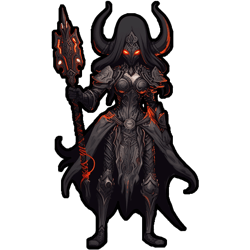
Ravenna made a bargain unlike any other. She did not trade blood or perform dark rituals. She simply had a conversation. She spoke to a god and whispered a simple question: "What if you could be more?" In that moment of hesitation, as doubt crept into the god's mind, his divinity fractured. And she took what slipped through the cracks.
This makes Ravenna unique among all living beings. She is the only one that makes deities nervous. Other beings threaten gods with force or cunning. Ravenna makes them doubt themselves. And in that doubt, she finds her opportunity.
She wields this power with cold, calculated grace. She does not need to rush or show emotion. She simply exists, and people fear her. Her presence is chilling. When she looks at someone, they feel their own mortality.
Philosophy
Ravenna does not tempt with lust or vengeance. She tempts with potential. She whispers to those who listen: "You could be more." People destroy themselves chasing what they already had, reaching for what they almost possessed. She does not corrupt them. She simply nudges their ambition and watches it consume them.
Ravenna often competes with Astaroth for control. But their conflict is not about domination. It is about methodology. Astaroth rules through chaos and destruction. Ravenna rules through inevitability. Where Astaroth destroys kingdoms, Ravenna makes kings beg her to end them.
Sometimes they align. He breaks the world. She rebuilds it in her image. This partnership terrifies the wise, for it means chaos followed by a cold, calculated order.
Her approach is fundamentally different from his. Astaroth weaves his dark plots openly across the world. Ravenna prefers to control the person who is doing the weaving. Her philosophy is simple. If someone else will do the work, why should she do it herself? This makes her more dangerous than Astaroth in many ways.
Nature
Ravenna is cold. Patient. Calculating. She can be pleasant and charming when it serves her purpose. She is unpredictable in her moods, yet always in control.
There is something strange about those who fall under her influence. They become silent. Withholding. Mistrustful of others. This is not by accident. Every secret spoken aloud weakens Ravenna. Every secret kept strengthens her. She feeds on silence.
There are moments when she shows inhuman restraint under pressure. There are other moments when she has killed in terrible fits of rage, even her own parents. These contradictions make her impossible to predict.
The people of Arvendor fear Ravenna more than they fear Astaroth. Astaroth is ruthless and destructive. He will destroy anything that gets in his way. But Ravenna is different. Her silence is what truly terrifies them. When you cannot see what someone is planning, you cannot prepare for it. And Ravenna is always planning something.
Lore
Some sailors whisper that the sirens, creatures that lure men to their doom at sea, are descended from her. Most people laugh this off as drunken talk. But the whispers persist. And in a world where gods were once real and the boundary between myth and reality is thin, such whispers deserve consideration.
Ravenna despises Mortem. Not because he represents death, but because he ends stories. She believes death should be meaningful, a tool, a lesson. Death should be part of a larger narrative. But Mortem's void erases her art. He destroys the careful designs she has constructed, the intricate webs of ambition and betrayal that take centuries to weave.
She once called Mortem "the god without poetry." Those few who heard her say it understood that it was the deepest insult she could offer. For Ravenna views the world as her canvas, and death as her brush. Mortem is the eraser that renders her work into nothing.